Can South African banks and insurers use AI voice agents under POPIA?
Yes. POPIA permits a South African bank or insurer to use an AI voice agent for customer calls, provided the processing is lawful, the information is secured, and any call that results in a decision affecting the customer materially is not left to the system alone.
The constraint is not the technology. It is the difference between answering a question and making a decision.
That distinction is the whole of it, and it is worth being precise about, because it is where most internal debates in a financial services contact centre get stuck. One side argues that AI cannot touch regulated customer interactions. The other argues that the volume is unsustainable without it. Both are describing different halves of the same call list.
What POPIA actually requires
The Protection of Personal Information Act, POPIA, does four things that matter in a contact centre.
You have to secure the information. The Act requires appropriate technical and organisational measures to protect personal information. A call recording containing an ID number, a balance and a claims history is personal information, and in this sector it is frequently special personal information as well. Encryption, access control, retention enforcement and breach notification all sit here. (Section 19.)
Anyone processing on your behalf has to be under contract. If a vendor handles personal information for you, the Act expects a written agreement obliging them to maintain those security measures and to process only on your instruction. An AI voice vendor falls into this category. So, usually, does the model provider sitting behind them, which is the part that gets missed. (Section 21.)
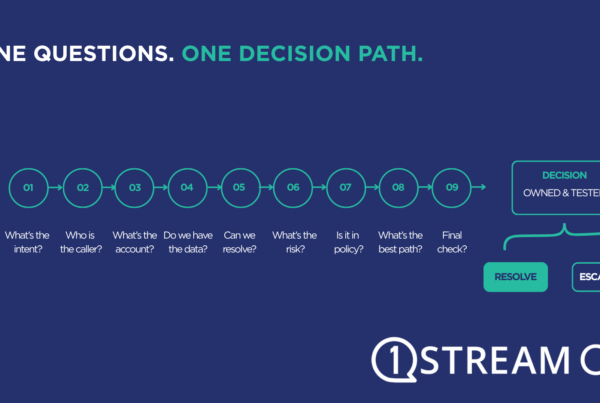
Decisions cannot be left to the machine alone. The Act restricts decisions based solely on automated processing where they carry legal consequences for a person or affect them to a substantial degree. This is the provision that decides which calls a bank can automate, and it is the one worth reading properly. (Section 71.)
Moving the data offshore is conditional. The Act places conditions on transferring personal information outside South Africa. Where the audio is processed, where the transcript is stored and which model provider sits behind the vendor all become live questions rather than procurement formalities. (Section 72.)
This is general information and not legal advice. Your compliance function should apply it to your own environment.
The calls that automate first
Lookups.
A balance enquiry. A statement request. A payment or debit order status. A claim status check. A policy detail confirmation. Each of these retrieves something already true and tells the customer. There is no judgement in it, no discretion and no consequence beyond the information itself.
The restriction on automated decisions does not engage, because nothing is being decided. Security, the operator contract and the offshore processing conditions are handled through architecture and contract rather than by keeping a person in the chair.
These are also, in most South African banks and insurers, a disproportionate share of inbound volume. Which makes the commercial argument and the compliance argument point in the same direction, something that does not happen often enough to ignore when it does.
The calls that do not
Anything with a decision in it.
Declining a claim. Approving or refusing credit. Setting a premium. Cancelling a policy. Any outcome the customer would want to argue with, in other words.
Those calls can be supported by AI, prepared by AI and routed intelligently by AI. The decision belongs to a person, and the customer needs a route to that person that is not buried.
The band in the middle
There is a third category worth naming, because it is where the design work actually lives.
A call that starts as a lookup and turns into a dispute. The customer phones to check a claim status, hears the status, and then challenges it. The call type changed while you were talking to them.
The system needs to recognise the turn and hand over cleanly, with the full context passed through, rather than continuing to try. That boundary is a configuration you own and can inspect, not a property of the model. Any vendor who describes it as something the AI works out for itself has answered the wrong question, and you should press until you get the right one.
What good governance looks like in practice
The compliance conversation in a bank rarely ends at the legal position. The next question is how you prove it, in an audit, eighteen months from now, about a call nobody remembers.
That is a management system question rather than a legal one.
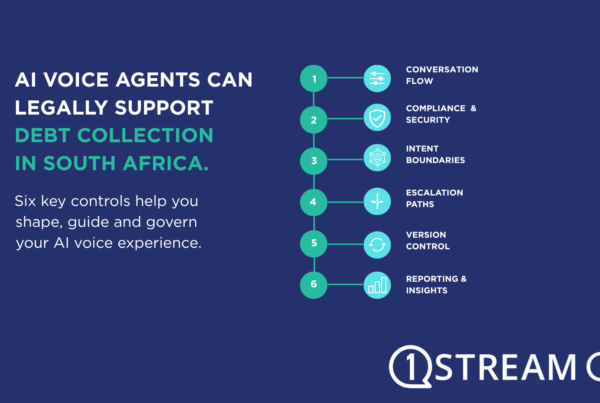
It means logging every automated interaction in a form you can retrieve and inspect yourself, including the transcript, the intent the system detected, the action it took and the version of the model that took it. It means controlling model changes so that behaviour you approved does not quietly shift. It means an assigned owner for AI risk who is not the person who bought the platform. And it means being able to show that all of this operates continuously rather than existing as a document somebody wrote once.
ISO/IEC 42001 is the international standard that sets out exactly that, and it is independently audited rather than self declared. South Africa has no AI law and the national framework is not expected before 2027, so for the moment independent certification is the only external evidence a compliance officer can rely on.
1Stream is certified to ISO/IEC 42001. A bank or insurer deploying our AI voice agent inherits that position rather than assembling one from scratch.
Where to start
Take your top ten call reasons by volume. Sort them into lookups and decisions.
Pick the highest volume lookup. Agree how you will measure it before anything is configured, resolution rate rather than containment, repeat contact inside seven days, agent handling time on the calls that still escalate, and customer satisfaction on the automated path on its own.
Then run it for four to six weeks on the telephony and CRM you already have. You will have a defensible number and a compliance answer before you have committed to anything.
Frequently asked questions
Is it legal to use an AI voice agent in a South African bank?
Yes, provided processing complies with the Protection of Personal Information Act. The Act restricts decisions taken solely by automated means that affect a person materially, so service and lookup calls are straightforward while decision calls require human involvement.
What does POPIA say about automated decisions in a contact centre?
It means an automated system should not be the sole decision maker where the outcome carries legal consequences or affects the customer substantially. Answering a balance query is not such a decision. Declining a claim is.
Can call recordings be processed outside South Africa?
Only under the conditions the Act sets for cross border transfers, which include an adequate level of protection in the receiving country or the data subject’s consent. Ask any vendor where audio and transcripts are processed and stored, and whether that changes when a third party model provider is used.
Which contact centre calls should a South African insurer automate first?
High volume lookups with no decision attached. Claim status, policy detail confirmation, payment and debit order status, and statement requests.
Does ISO/IEC 42001 certification satisfy POPIA?
No. It is a management system standard rather than a legal instrument and it does not replace compliance with POPIA. It provides audited evidence that AI is governed deliberately, which is what a compliance officer needs when the law itself offers no AI specific benchmark.
Where to go from here
Book a CX AI Readiness Assessment for a forty five minute session and a written recommendation on which of your call reasons automate first. If you would rather test it than discuss it, request an AI Voice POC on one call type.
Book a CX AI Readiness Assessment
This article is general information for buyers evaluating AI voice platforms. It is not legal advice. Organisations should obtain their own legal and compliance guidance on POPIA as it applies to their environment.