By Bruce von Maltitz, co-founder, 1Stream
South Africans are more willing to talk about an overdue account when the voice on the other end of the line has no opinion about them. On the collections deployments we have measured, an AI voice agent secures a promise to pay 10 percentage points more often than a live agent, with average handle time 25% lower, in certain instances. This piece is about why that happens, and the rules that have to be in place for it to be lawful.
The book is bigger and the accounts are smaller
The numbers have moved since I first wrote about this in June, and they have moved in one direction.
Eighty20 and XDS put 41% of credit-active South Africans in default on at least one loan in the first quarter of 2026, with overdue debt up 5.6% in a single quarter. TransUnion’s second quarter Consumer Pulse found 39% of consumers expecting to miss at least one bill or loan repayment. Experian’s default index tells the most useful story of all: retail loan defaults rose 11% year-on-year to 17.18%, while home loan defaults fell 16%.
South Africans are protecting the house and letting the store account slip. That is a rational choice made by people under pressure, and it means the accounts going into arrears are the small ones. The ones that have never justified a trained collector’s time.
Why the call is so hard for everyone
A collections call is the most dreaded call a consumer takes. The person on the other end knows they are behind, usually knows why, and does not want to explain it to a stranger who sounds tired, or worse, sounds sympathetic.
It is not a good call for the collector either. The same conversation forty times a day, most of it identity confirmation and balance reading, with the difficult ones mixed in unpredictably.
So the customer avoids the call and the collector rushes it. The account ages, and by the time anyone is talking to anyone the arrangement that was possible on day five is not possible on day sixty.
What changes when the agent is not a witness
The AI voice agent is not a better negotiator than a good collector. It is consistent, and it does not bring human judgement, impatience or embarrassment into the conversation.
It only asks what is relevant: are you the account holder, here is the balance, what can you manage and when. It confirms rather than interrogates. It does not sigh, does not sound disappointed and does not let the call run long because it is trying to be kind.
Customers respond to that. I have listened to people tell an AI voice agent, calmly, what they can pay and on what date, when they would have avoided the same call from a person for weeks. It is not that the agent is friendlier. It is that it is not a witness to a hard choice.
That is where the promise to pay improvement comes from. And because the agent only records a promise to pay when it has a date, an amount and a channel, and writes all three back to the credit system, the improvement is a real number, not sentiment.
The controls that govern the process
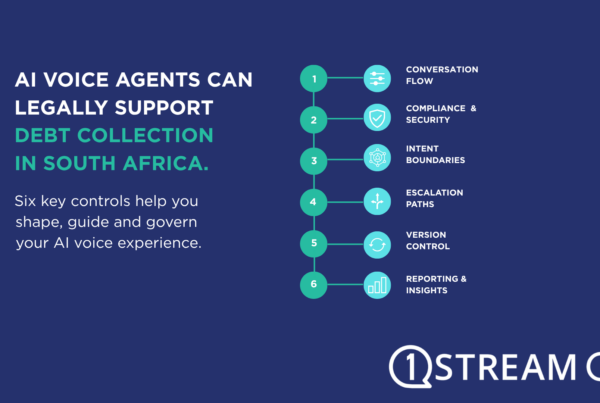
None of this works without clear rules. On a 1Stream deployment the AI voice agent:
- States which business it is calling for and follows that business’s approved disclosure script
- Confirms it is speaking to the account holder before it discloses anything
- Contacts customers on a lawful basis, inside the hours and frequency the credit provider sets
- Offers only arrangements the credit provider has approved
- Follows the approved dispute process and moves requests for a person, distress, hardship, debt review or legal representation through their configured next steps, including transfer where required
- Logs every call: identity confirmed, disclosure made, arrangement offered, outcome and next-step reason
Those are configured rules, tested before going live and audited after it. 1Stream is certified to ISO/IEC 42001 for AI management, which is what turns that list into evidence a legal or compliance team can assess. It does not make any deployment compliant on its own. That is the credit provider’s design, and the rules above are how it is built.
We have written the full guide to what POPIA, the National Credit Act and the Debt Collectors Act require of an AI voice agent on a collections call. It is on 1stream.co.za.
Coverage is the bigger operational return
A 25% reduction in handle time is an efficiency gain. Its bigger operational effect is coverage.
Less time per call means far more of the book gets a call in the first days of the month, within the calling windows and contact data the business has in place, not just the accounts at the top of the list. The R900 store account gets called. The customer who is twenty days late, not ninety, gets called. Those are the accounts that decide whether a book rolls or recovers, and a human desk never gets to them because the day runs out.
Reach the whole book early, every month, and the big balances take care of themselves because fewer of them get there.
Why this matters before the festive season
Going into last year’s festive season, TransUnion found 36% of consumers expected to miss a payment and 36% planned to take on new credit or refinance to bridge it. That credit lands as arrears in January and February. Every retailer and credit provider knows it.
The question is how the January book will be worked. The desks that will cope are deciding that now, in October, because six weeks is enough to get one collections workflow live if the scope is kept tight: one call type, one integration, one handover path.
In summary
- Retail credit defaults are rising while home loan defaults fall. The accounts slipping are small, and a human desk has never been able to reach them at volume.
- Consumers are more comfortable talking to an AI voice agent about an overdue account because it asks only what is relevant and has no tone. On measured deployments that shows up as a promise to pay rate 10 percentage points higher than live agents, in certain instances.
- The deployment must be designed around the applicable rules: the agent follows the approved identification and disclosure script, confirms identity before disclosure, offers only approved arrangements, follows the configured dispute and escalation process, and logs every call. Certification to ISO/IEC 42001 makes those controls auditable.
- Lower handle time is an efficiency gain whose bigger operational effect is coverage. Coverage before the January book lands is the decision being made this month.
We have been building contact centre platforms in South Africa for eighteen years. The AI voice agent is live, it is certified, and it works on a real book. English and Afrikaans today, with more South African languages on the way.
If you want to know where it fits on yours, book a CX AI Readiness Assessment. Forty five minutes, and you leave with a written recommendation.
Sources: Eighty20/XDS Credit Stress Report Q1 2026 (eighty20.co.za/credit-stress-report); Experian Consumer Default Index Q1 2026 (reported by Business Day, 17 June 2026); TransUnion Consumer Pulse Q2 2026 (newsroom.transunion.co.za) and Q4 2025 (reported by Business Report, 31 January 2026); 1Stream deployment data, 2026.